

Neural Networks#
Artificial neural networks (ANN) or connectionist systems are computing systems vaguely inspired by the biological neural networks that constitute animal brains.
The neural network itself isn’t an algorithm, but rather a framework for many different machine learning algorithms to work together and process complex data inputs.
Such systems “learn” to perform tasks by considering examples, generally without being programmed with any task-specific rules.
They do this without any prior knowledge about cats, e.g., that they have fur, tails, whiskers and cat-like faces. Instead, they automatically generate identifying characteristics from the learning material that they process.
An ANN is based on a collection of connected units or nodes called artificial neurons, which loosely model the neurons in a biological brain.
Each connection, like the synapses in a biological brain, can transmit a signal from one artificial neuron to another. An artificial neuron that receives a signal can process it and then signal additional artificial neurons connected to it.

In common ANN implementations, the signal at a connection between artificial neurons is a real number, and the output of each artificial neuron is computed by some non-linear function of the sum of its inputs.
The connections between artificial neurons are called edges.Artificial neurons and edges typically have a weight that adjusts as learning proceeds.
The weight increases or decreases the strength of the signal at a connection. Artificial neurons may have a threshold such that the signal is only sent if the aggregate signal crosses that threshold.
Typically, artificial neurons are aggregated into layers. Different layers may perform different kinds of transformations on their inputs. Signals travel from the first layer (the input layer), to the last layer (the output layer), possibly after traversing the inner layers multiple times.

A multilayer perceptron (MLP) is a class of feedforward artificial neural network. An MLP consists of, at least, three layers of nodes:
an input layer,
a hidden layer and
an output layer.
Except for the input nodes, each node is a neuron that uses a nonlinear activation function.
MLP utilizes a supervised learning technique called backpropagation for training.
Its multiple layers and non-linear activation distinguish MLP from a linear perceptron.
It can distinguish data that is not linearly separable.
Neuron Model (Logistic Unit)#
Here is a model of one neuron unit.


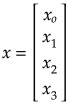
Weights:
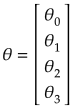
Here, we are adding non linearity to input features by passing it through an activation function
Network Model (Set of Neurons)#
Above we saw just 1 neuron , but a Neural network consists of multiple layers of multiple neuron units interconnected with each other.
Let’s take a look at simple example model with one hidden layer.

 - “activation” of unit i in layer j.
 - matrix of weights controlling function mapping from layer j to layer j + 1. For example for the first layer:
  .
.
 - total number of layers in network (3 in our example).
 - number of units (not counting bias unit) in layer l.
 - number of output units (1 in our example but could be any real number for multi-class classification).
Multi-class Classification#
In order to make neural network to work with multi-class notification we may use One-vs-All approach.
Let’s say we want our network to distinguish if there is a pedestrian or car of motorcycle or truck is on the image.
Input layer will be much bigger and it will have all the pixel from the image.
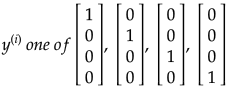
The output layer of our network will have 4 units, each unit will represent the different classes (pedestrian, car, motorcycle and truck).
If the model outputs a pedestrian, then pedestrian unit will provide a true signal (1) and rest false (0)
Let’s say if all our images will be 20x20 pixels then the input layer will have 400 units each of which will contain the black-white color of the corresponding picture).


In this case we would expect our final hypothesis to have following values:
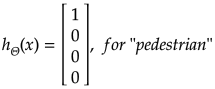
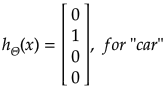
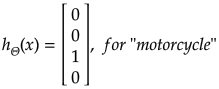
In this case for the training set:

We would have: